BYOC PrivateLink
PrivateLink is a connectivity capability for both BYOC and BYO-VPC, not a third deployment mode or an offline mode. It carries management traffic between the control plane agent and your generated control plane over private connectivity instead of the public internet, while preserving the customer's account and network ownership.
Use it when customers require private control-plane connectivity, restricted public exposure, or tighter egress policies. The endpoint setup, routing, and DNS configuration follow the customer's cloud and network topology. The implementation details below illustrate an AWS deployment, not a restriction on which clouds can use private connectivity.
Connectivity Setup
Start with the BYOC customer-account onboarding workflow. The portal and CLI onboarding commands are general BYOC operations; private connectivity adds the management endpoint and its network configuration.
BYOC PrivateLink Architecture
The following diagram shows the AWS endpoint implementation:
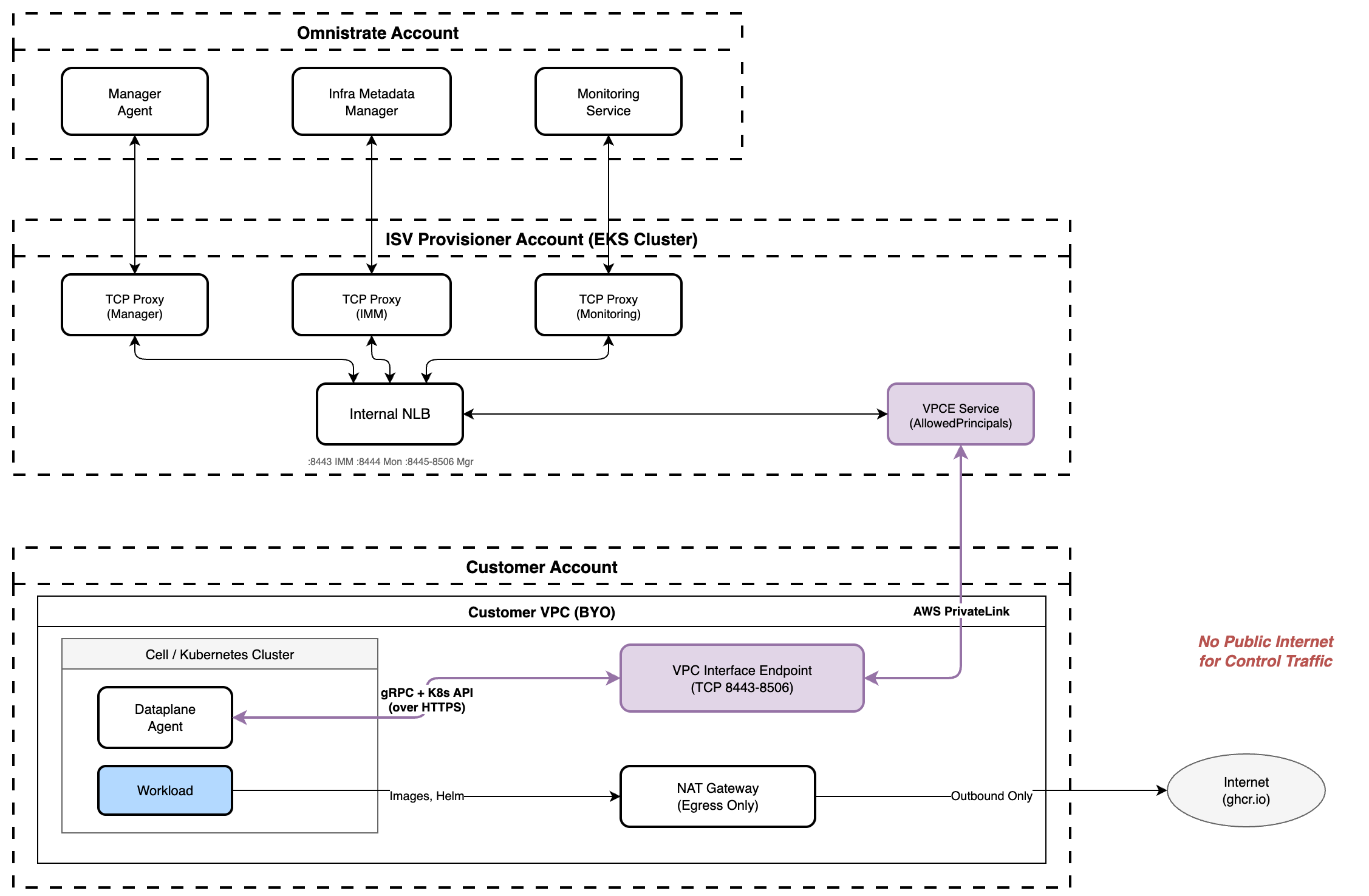
In this example, the control plane agent connects through a VPC Interface Endpoint targeting the endpoint service your control plane provides. When the account first onboards, your control plane configures the endpoint service and adds the customer's account to its AllowedPrincipals list. Control traffic does not traverse the public internet.
Customer VPC Topology
Private connectivity works with both network ownership modes:
- Control-plane-managed VPC — Your control plane provisions the VPC, subnets, security group, and required endpoints on first deployment. Networks with outbound egress include a NAT gateway; endpoint-only networks use private service endpoints. Network creation must be allowed during account onboarding. See Control-plane-managed VPC for the AWS setup.
- Customer-owned VPC (BYO-VPC) — The customer supplies the network, subnets, routes, DNS, and management endpoint. Your generated control plane validates connectivity and deploys within the supplied network. See Imported VPC requirements for the AWS setup.
AWS Endpoint Configuration Example
For an existing AWS VPC, prepare the following resources:
| # | Requirement | Details |
|---|---|---|
| 1 | VPC & subnet tags | Tag the VPC and workload subnets with omnistrate.com/managed-by = omnistrate. This tag gates IAM permissions and selects subnets for EKS nodegroup placement — tag only the subnets intended for workloads. |
| 2 | DNS settings | Enable DNS hostnames (enableDnsHostnames) and DNS resolution (enableDnsSupport). |
| 3 | Cloud service and artifact connectivity | Provide approved outbound egress or the complete endpoint-only set. |
| 4 | Management VPC Endpoint | Create an Interface VPC Endpoint targeting the service name your control plane provides. Tag it Name = omnistrate-byoc-private-vpce-<provisioner-hc-id>. Its security groups must allow inbound TCP 8443–8506 from the VPC CIDR and carry omnistrate.com/managed-by = omnistrate for debug-access rule management. |
| 5 | Cross-region (if applicable) | If the customer VPC and endpoint service are in different AWS regions, pass --service-region <region> when creating the endpoint, or service_region in Terraform. Leave private DNS disabled for cross-region interface endpoints. |
| 6 | Subnet tags (optional) | Tag private subnets with kubernetes.io/role/internal-elb = 1, and public subnets with kubernetes.io/role/elb = 1 when using the corresponding load balancers. |
Note
Your control plane provides the endpoint service name and provisioner host-cluster ID after account onboarding. Both are needed to create the AWS management endpoint.
For complete topology, routing, DNS, and security-group requirements, see Imported VPC requirements for BYOC PrivateLink.
CloudFormation Controls
In the AWS onboarding stack, AgentInfrastructureMutationEnabled controls infrastructure mutation. For private-connectivity host clusters, DataplaneKubernetesAccessRole controls the agent's Kubernetes permissions and K8sDebugAccessEnabled controls the debug-access network path. DataplaneKubernetesAccessTargets and K8sDebugAccessTargets scope the Kubernetes controls to regions or host clusters. See AWS CloudFormation Account Controls for values, updates, and verification.
Artifact Delivery Without Internet Access
A private management connection does not automatically provide access to cloud APIs or deployment artifacts. Configure the required service endpoints or approved egress paths for images, Helm charts, and Terraform or OpenTofu dependencies. For the AWS endpoint-only configuration, see endpoint-only connectivity and private registry configuration.